
How Long Does Stroke Rehabilitation Take? Recovery Timeline
How long stroke rehab takes depends on severity, timing and therapy dose. What recovery looks like if rehab starts early, at 3 months or after a year.
Read MoreA PMR (Physical Medicine and Rehabilitation) doctor, also called a physiatrist or rehabilitation physician, is a medical specialist who assesses how an illness or injury affects movement and daily function, plans and leads the rehabilitation team, and manages medical complications. See one early — once the patient is medically stable — after a stroke, spinal cord injury, brain injury or other neurological condition.

When someone has a neurological condition such as a stroke, spinal cord injury, Parkinson's disease or traumatic brain injury, the family often rushes to hospital for emergency treatment or surgery. After discharge, however, they may face new challenges: difficulty with body movements, sitting balance, standing, walking and everyday activities (activities of daily living, or ADLs). Many patients become dependent on family members or caregivers, leaving families unsure how to help them regain independence.
This is where a PM&R doctor plays an important role.
At Rehabana, the PM&R doctor directly assesses the patient's condition, movement abilities and functional limitations. Based on this assessment, the doctor explains the patient's current condition and recovery possibilities to the family and guides them through the next steps.
The doctor also plans an individualised rehabilitation programme delivered by our multidisciplinary team — physiotherapists, occupational therapists, speech therapists and psychologists. When needed, the doctor recommends orthoses (supports for weak or affected body parts) and assistive devices to help patients stand, walk and perform daily activities more safely and independently.

After a stroke, spinal cord injury, Parkinson's disease or traumatic brain injury, starting rehabilitation early — once the patient is medically stable — helps identify functional difficulties and plan appropriate treatment.
During rehabilitation, patients may develop other problems, such as changes in blood pressure, shoulder pain after stroke, urinary difficulties, constipation (particularly after spinal cord injury) or restlessness during therapy sessions. These problems can affect the patient's ability to take part in rehabilitation. This is why early consultation with a PM&R doctor matters.
At Rehabana, our PM&R doctor works closely with the multidisciplinary team (MDT) to:
With the PM&R doctor's guidance, the MDT can deliver rehabilitation in a more coordinated way while addressing associated medical and functional problems. This doctor-led coordination is central to both outpatient care and inpatient rehabilitation at Rehabana.

Therapy can help, but without a PMR doctor medical issues that block progress are easily missed. During rehabilitation, the team may identify medical and functional difficulties that need a doctor's input — sudden blood pressure changes, post-stroke shoulder pain, urinary problems, constipation or restlessness during sessions. The PM&R doctor helps manage these problems, decides which orthoses or supports are needed, and sets the number of sessions and therapy intensity according to the patient's condition and response.
Under the PM&R doctor's supervision, these health problems can be addressed alongside rehabilitation, so the therapy team can work more safely and effectively. The doctor also regularly reviews progress, identifies where improvement has become difficult, and discusses solutions with the team. This is also why the difference between physiotherapy and full rehabilitation matters.
At Rehabana, our PM&R doctors use standard assessment scales during the OPD consultation to evaluate the patient's condition, identify the severity of impairment and understand functional abilities. Depending on the condition, these may include:
Assessment / scale | What it assesses |
|---|---|
Rancho Los Amigos Levels of Cognitive Functioning | Level of awareness, thinking, memory, behaviour and response to the environment after a brain injury |
Expanded Disability Status Scale (EDSS) | Level of disability and functional difficulty, mainly in multiple sclerosis (MS) |
GMFCS / MACS / CFCS | How children with cerebral palsy perform gross motor activities, use their hands and communicate in daily life |
Van Middendorp clinical prediction rule (SCI) | Likelihood of independent walking after spinal cord injury, based on specific clinical findings |
Hoehn & Yahr stage | Severity and stage of Parkinson's disease, based mainly on movement and balance |
SAFE score | Shoulder abduction and finger extension strength after stroke, to help predict upper-limb recovery potential |
Trunk Control Test (TCT) | Ability to roll in bed, sit up and keep sitting balance after a stroke |
Glasgow Coma Scale (GCS) | Level of consciousness, from eye opening, verbal response and movement |
Saddle anaesthesia and urinary retention | Sudden loss of sensation with difficulty passing urine may signal serious nerve compression, such as cauda equina syndrome, and needs urgent medical assessment |
After the initial assessment, progress is monitored regularly with functional assessment tools, and the plan is modified when needed:
See how these scores are used in practice in how long rehabilitation takes after a stroke.
During rehabilitation, some patients develop secondary complications such as joint pain, muscle tightness, spasticity, contractures, swelling, wounds or restricted joint movement. These problems can interfere with therapy and slow functional recovery.
At Rehabana, our PM&R doctor evaluates these complications and provides medical or procedural treatment when required. Depending on the patient's condition, this may include:
Consider a PM&R consultation if you or a family member:
Choosing a centre for a brain injury? Our 9-point TBI rehabilitation centre checklist can help.
No. A PM&R doctor is a medical specialist who evaluates overall rehabilitation needs, manages medical complications and develops the rehabilitation plan. A physiotherapist works on movement, strength, balance and mobility as part of that plan.
A PM&R doctor is also called a physiatrist, rehabilitation physician or Physical Medicine and Rehabilitation specialist.
Yes — an early rehabilitation assessment is helpful once the patient is medically stable. It allows the team to identify functional difficulties and plan appropriate rehabilitation.
Yes. Even patients who start rehabilitation several years after a stroke can be assessed. Depending on their condition, they may still work towards better movement, balance and independence, although the amount of improvement varies.
No. Every patient has different difficulties, medical conditions and goals. The PM&R doctor develops an individualised rehabilitation plan according to these needs.
At Rehabana, our goal is not just to help patients move again, but to help them regain as much independence as possible in everyday life.
Book an OPD consultation with a Rehabana PM&R doctor for a full functional assessment and a personalised rehabilitation plan.
Knowledge That Guides Recovery
Get expert neuro rehabilitation tips from the doctors at Rehabana, Kolkata — simple guidance on stroke recovery, spinal cord injury rehab, Parkinson’s care, and enhancing quality of life after neurological conditions.
How long stroke rehab takes depends on severity, timing and therapy dose. What recovery looks like if rehab starts early, at 3 months or after a year.
Read More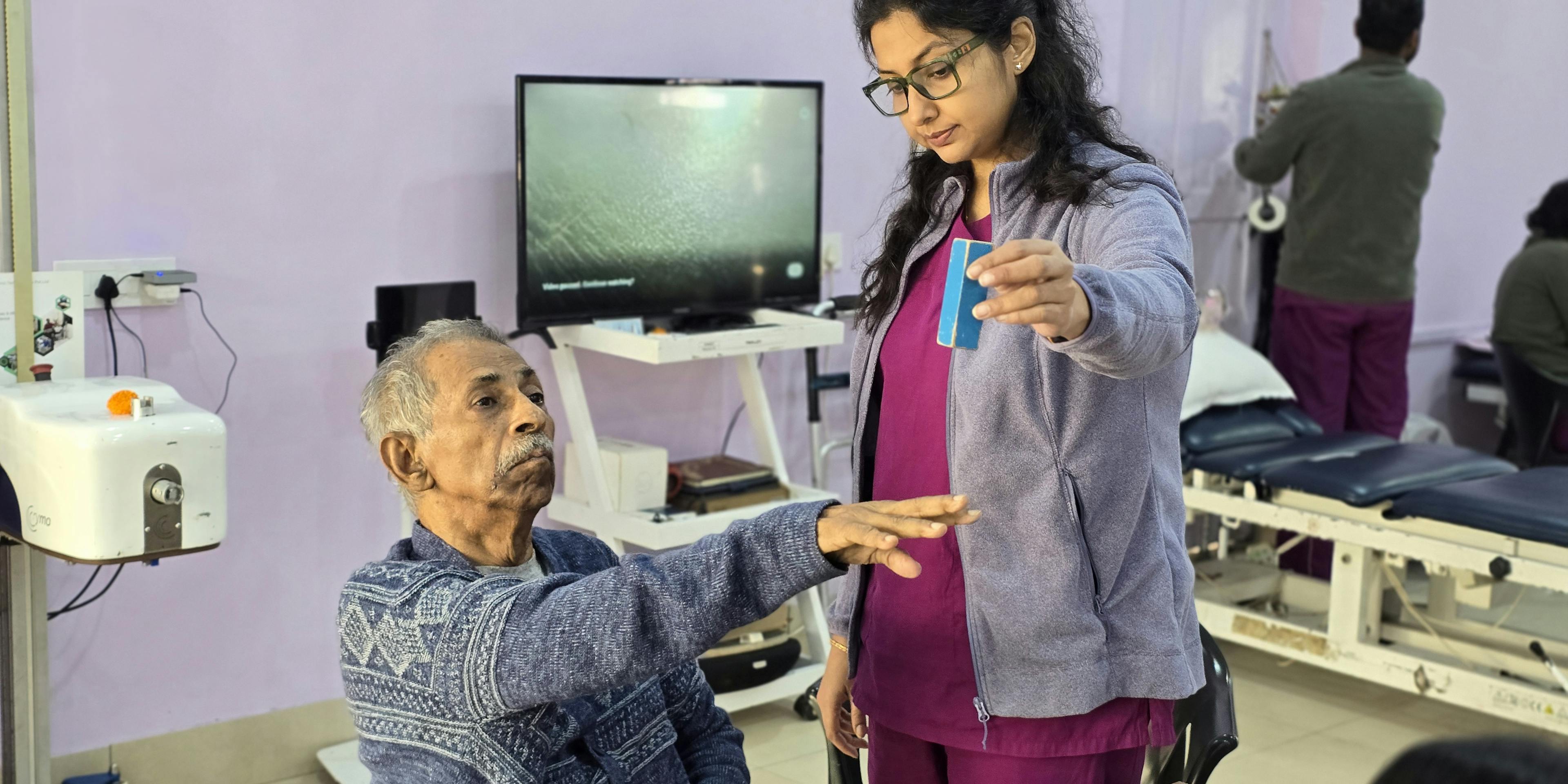
Physiotherapy vs occupational therapy: PT improves movement, strength and walking; OT builds daily skills like eating and dressing. When you need both.
Read More
Choosing a traumatic brain injury rehab centre in Kolkata? Use this 9-point checklist: PM&R-led assessment, family training, progress reports and more.
Read More