
How Long Does Stroke Rehabilitation Take? Recovery Timeline
How long stroke rehab takes depends on severity, timing and therapy dose. What recovery looks like if rehab starts early, at 3 months or after a year.
Read MoreYes — neuroplasticity, the brain's ability to change its connections through experience and practice, can support learning during rehabilitation after a stroke or traumatic brain injury. It helps explain why repeated, meaningful practice matters, but it does not guarantee recovery or a particular result.

After a stroke or traumatic brain injury (TBI), some people have difficulty with movement, balance, communication or everyday activities such as eating and dressing. The effects differ from person to person.
Rehabilitation may use repeated, meaningful practice to work on activities that matter to a person. The type of practice and whether it is suitable depend on an individual assessment.

The brain uses networks of connected nerve cells to control movement and other activities. An injury can disrupt these networks, making familiar tasks harder.
The brain can change with learning and experience. Rehabilitation provides opportunities to practise relevant skills; the amount and type of change vary, and practice does not ensure that a function will return.
Repetition is part of practice, but the activity, its difficulty and the amount should suit the person. A clinician — usually guided by a PM&R (rehabilitation) doctor — should guide changes to an individual rehabilitation plan.
Rehabilitation built on neuroplasticity principles may address goals such as:
Progress varies. It can depend on the condition, the effects of the injury, general health and other individual factors. A qualified clinician can discuss what is realistic for a particular person.
Neurological rehabilitation helps people regain abilities and become as independent as possible in daily life. It focuses on learning and practising activities according to each person's needs and abilities.
At Rehabana, therapy is planned around the patient's individual goals and functional needs. Our multidisciplinary team works together, using current evidence-based approaches, to support recovery.
Rehabilitation also encourages patients to use the weaker or less active side of the body instead of depending only on the stronger side. Improvements come through better motor learning and control — relearning how to use a body part and control its movements.
At Rehabana, we introduce mirror therapy as early as clinically appropriate. Some patients take time to accept the loss of movement in their affected hand or arm.
During mirror therapy, the affected hand is placed behind a mirror and the unaffected hand in front of it. When the patient moves the unaffected hand, the reflection creates the illusion that the affected hand is moving too. This visual feedback helps the brain recognise and imagine movement on the affected side.
We may also use Functional Electrical Stimulation (FES) to create muscle contractions that support movement practice, alongside technology such as robotic rehabilitation where suitable.

No. Neuroplasticity may support learning, but it does not guarantee complete recovery.
Recovery differs from person to person. The effects of the injury, overall health and other individual circumstances all matter, and a clinician can discuss a person's situation. Some people continue to need assistance or adaptive strategies — read more about what full recovery after stroke can realistically mean.
Neuroplasticity principles can be used from the early stage of neurological rehabilitation and continued throughout recovery. The timing and type of therapy depend on the patient's medical condition and recovery stage.
Wondering how this translates into weeks and months? See how long rehabilitation takes after a stroke.

Neuroplasticity describes the brain's capacity to change with experience and practice. What this means for an individual's recovery is uncertain and varies.
The practical question is whether a person can work towards activities that matter to them, with appropriate support, realistic goals and regular progress review.
If movement, communication or daily activities are difficult after a stroke or brain injury, ask a qualified health professional about an individual rehabilitation assessment. At Rehabana, this starts with a PM&R doctor consultation in Kolkata.
Neuroplasticity is the brain's ability to reorganise and change its connections when you learn or practise something. After an injury, rehabilitation uses this ability to help the brain relearn movements and daily skills.
The brain can form and strengthen connections after a stroke, especially with repeated, meaningful practice. How much function returns varies widely and depends on the size and location of the stroke, overall health and the rehabilitation received.
Not necessarily. Neuroplasticity continues in the chronic stage, months or years after injury, so continued task-based practice can still help some people. Improvement is often slower than in the early months.
Follow the home programme your therapists give you, practise meaningful daily tasks regularly, and use the affected side where it is safe. Do not increase intensity without guidance from your rehabilitation team.
Mirror therapy uses a mirror's reflection to create the illusion that an affected limb is moving. This visual feedback can help the brain recognise and imagine movement on the affected side, and it is often used for the arm and hand after a stroke.
Our PMR doctors assess each patient and plan task-specific therapy — from mirror therapy to robotic training — around realistic, personal goals.
Knowledge That Guides Recovery
Get expert neuro rehabilitation tips from the doctors at Rehabana, Kolkata — simple guidance on stroke recovery, spinal cord injury rehab, Parkinson’s care, and enhancing quality of life after neurological conditions.
How long stroke rehab takes depends on severity, timing and therapy dose. What recovery looks like if rehab starts early, at 3 months or after a year.
Read More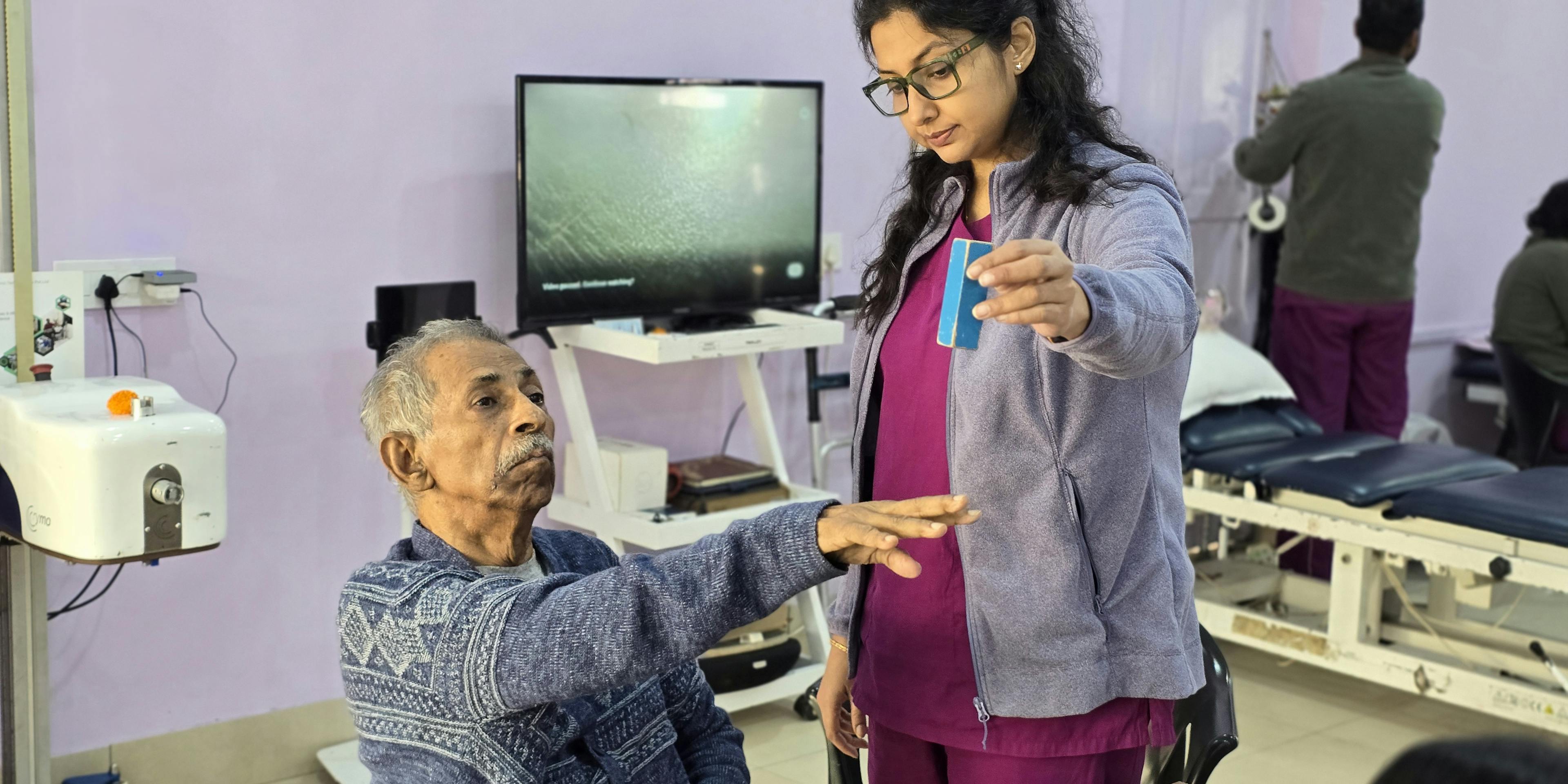
Physiotherapy vs occupational therapy: PT improves movement, strength and walking; OT builds daily skills like eating and dressing. When you need both.
Read More
Choosing a traumatic brain injury rehab centre in Kolkata? Use this 9-point checklist: PM&R-led assessment, family training, progress reports and more.
Read More