
How Long Does Stroke Rehabilitation Take? Recovery Timeline
How long stroke rehab takes depends on severity, timing and therapy dose. What recovery looks like if rehab starts early, at 3 months or after a year.
Read MoreBalance training helps elderly adults walk more safely by improving both static balance (staying steady in one position) and dynamic balance (staying steady while moving). Many older adults have enough strength to walk but still feel unsteady, so targeted, assessed balance training can improve control and confidence and help reduce fall risk.

Balance is an important part of safe walking. An elderly person may have enough muscle strength to stand or walk but still feel unsteady because of poor balance. This can reduce walking confidence and increase the risk of falling.
At Rehabana, we know that improving muscle strength alone is not always enough to improve walking. Some patients need specific balance training to regain body control, walking confidence and safety during daily activities such as moving from a bed to a chair.
Walking is not only about muscle strength. It also requires the body to stay balanced while shifting weight from one leg to the other. When balance is poor, an elderly person may:
For example, some patients can stand up from a chair and take a few steps on their own. But when they start walking, turn or change direction, they feel unsteady, become afraid of falling and start depending on another person.
So the first step is to assess a person's ability to stay balanced while standing up from sitting, and while turning and moving in different directions, with or without support. A good balance programme for older adults includes both static and dynamic balance.
Both are important for safe walking and everyday activities.

We do not depend only on manual exercises or conventional equipment. We also use robotic balance training technology to assess, train and customise balance training. The purpose is to understand where the patient is having difficulty and plan training according to their needs.
We assess the patient's ability to stay balanced while standing and moving, and identify whether the main difficulty is static balance, dynamic balance or both. We use standard scales such as the Berg Balance Scale (BBS) and the Timed Up and Go (TUG) test.
Example from a Rehabana case report (shared without identifying details):
Assessment | 15 Aug 2026 | 15 Sep 2026 | 10 Oct 2026 | What it shows |
|---|---|---|---|---|
Berg Balance Scale (out of 56) | 3/56 | 10/56 | 19/56 | Improvement in balance performance |
Timed Up and Go (TUG) | 2 min 12 sec | — | 1 min 2 sec | Improvement in functional mobility |
We use computerised, sensor-based robotic balance training to help patients practise maintaining and controlling their body position. The training provides structured activities matched to the patient's ability. Learn more about robotic rehabilitation in Kolkata.
The system generates reports that help the clinical team understand the patient's balance performance. These reports can help identify:
After identifying the balance difficulties, we work on activities that matter in daily life, such as:
The rehabilitation plan is adjusted according to the patient's progress and safety, as part of our physiotherapy in Kolkata.

We use computerised balance training reports to monitor a patient's performance over repeated sessions. For example, a 72-year-old man took part in seven rehabilitation sessions. His static balance training report dated 3 October 2026 showed the following:
Training parameter | Second-last session | Latest session |
|---|---|---|
Balance time | 1 min 57 sec | 3 min |
Imbalance time | 3 sec | 0 sec |
Falls recorded | 1.5 falls/min | 0 falls/min |
This shows how technology can support assessment and progress monitoring. However, improvement during a training activity does not automatically mean the patient is safe walking independently — walking ability and real-life balance must also be assessed.
Balance training can help patients develop better control over their body movements. When patients feel more stable while standing, shifting their weight and taking steps, they may gradually become more confident when walking.
At Rehabana, our goal is to help patients use their improved balance in everyday activities, such as:
Balance difficulties can affect more than walking. They can also affect daily activities, confidence, physical independence and emotional well-being. We follow a holistic, team-based approach. Depending on the patient's needs, the team may include:
The team works together to identify the patient's difficulties, set goals and monitor progress. Our aim is not simply to help patients stand or walk, but to help them regain confidence, take part in everyday activities and move towards greater independence. Balance problems linked to neurological conditions are covered in our guides on Parkinson's gait and balance and MS balance and coordination.
There is no single best exercise. A good programme includes both static balance (standing steadily) and dynamic balance (weight shifting, stepping, turning), progressed safely after an assessment by a physiotherapist.
Common tests include the Berg Balance Scale, scored out of 56, and the Timed Up and Go (TUG) test, which times how long a person takes to stand up, walk a short distance, turn and sit back down. At Rehabana, computerised balance reports add further detail.
Balance training can reduce fall risk by improving body control and walking confidence. It works best alongside a review of other risk factors, such as medicines, eyesight, footwear and home safety.
It varies with the person's condition, starting level and how regularly they train. Some people notice changes within a few weeks of regular, supervised sessions, while others need longer.
Robotic balance training is carried out under therapist supervision, with activities matched to the patient's ability. Suitability is decided after an individual assessment.
Our team assesses static and dynamic balance and builds a personalised, supervised training plan — including robotic balance training where suitable.
Knowledge That Guides Recovery
Get expert neuro rehabilitation tips from the doctors at Rehabana, Kolkata — simple guidance on stroke recovery, spinal cord injury rehab, Parkinson’s care, and enhancing quality of life after neurological conditions.
How long stroke rehab takes depends on severity, timing and therapy dose. What recovery looks like if rehab starts early, at 3 months or after a year.
Read More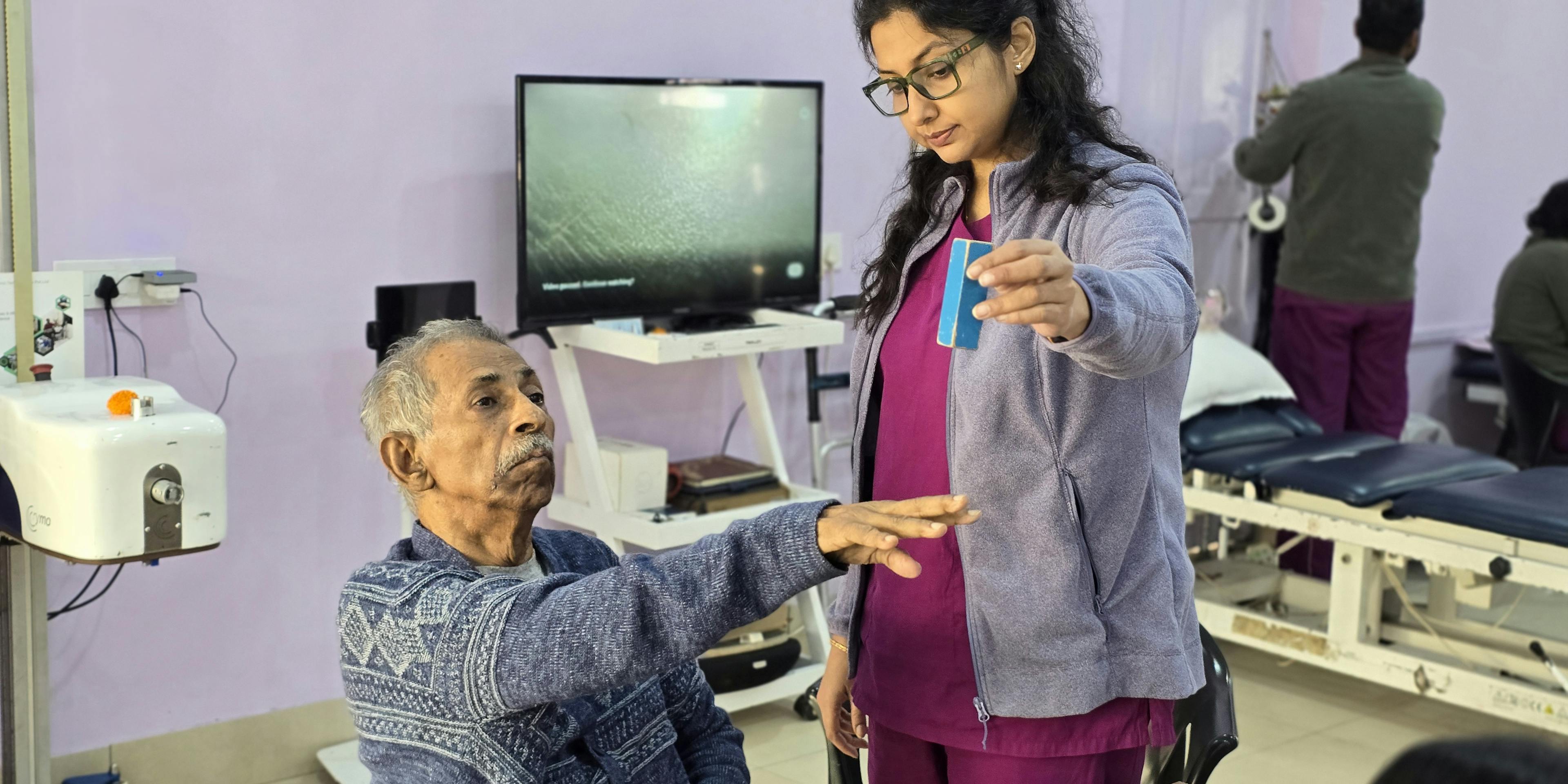
Physiotherapy vs occupational therapy: PT improves movement, strength and walking; OT builds daily skills like eating and dressing. When you need both.
Read More
Choosing a traumatic brain injury rehab centre in Kolkata? Use this 9-point checklist: PM&R-led assessment, family training, progress reports and more.
Read More