Rehabilitation for Parkinson's Disease

A guide to Parkinson's rehabilitation: the multidisciplinary team, what each therapy does, how goals are set at each stage, and why starting early matters.

Parkinson's rehabilitation session at Rehabana, Kolkata

Overview

What Parkinson's rehabilitation aims to do

Parkinson's rehabilitation is a planned programme of therapy that helps people keep moving, speaking and managing daily life as well as possible. It works alongside the medicines your neurologist prescribes. Medicines replace missing dopamine. Rehab trains the body and brain to make the most of what they can do, and teaches strategies for problems medicines don't fix well, such as balance, freezing and swallowing.

Rehab is not one fixed course. The goals shift as the condition changes, from staying fit early on to staying safe and comfortable later. What stays the same is the starting point: what you want to be able to do.

Read the full Parkinson's guide
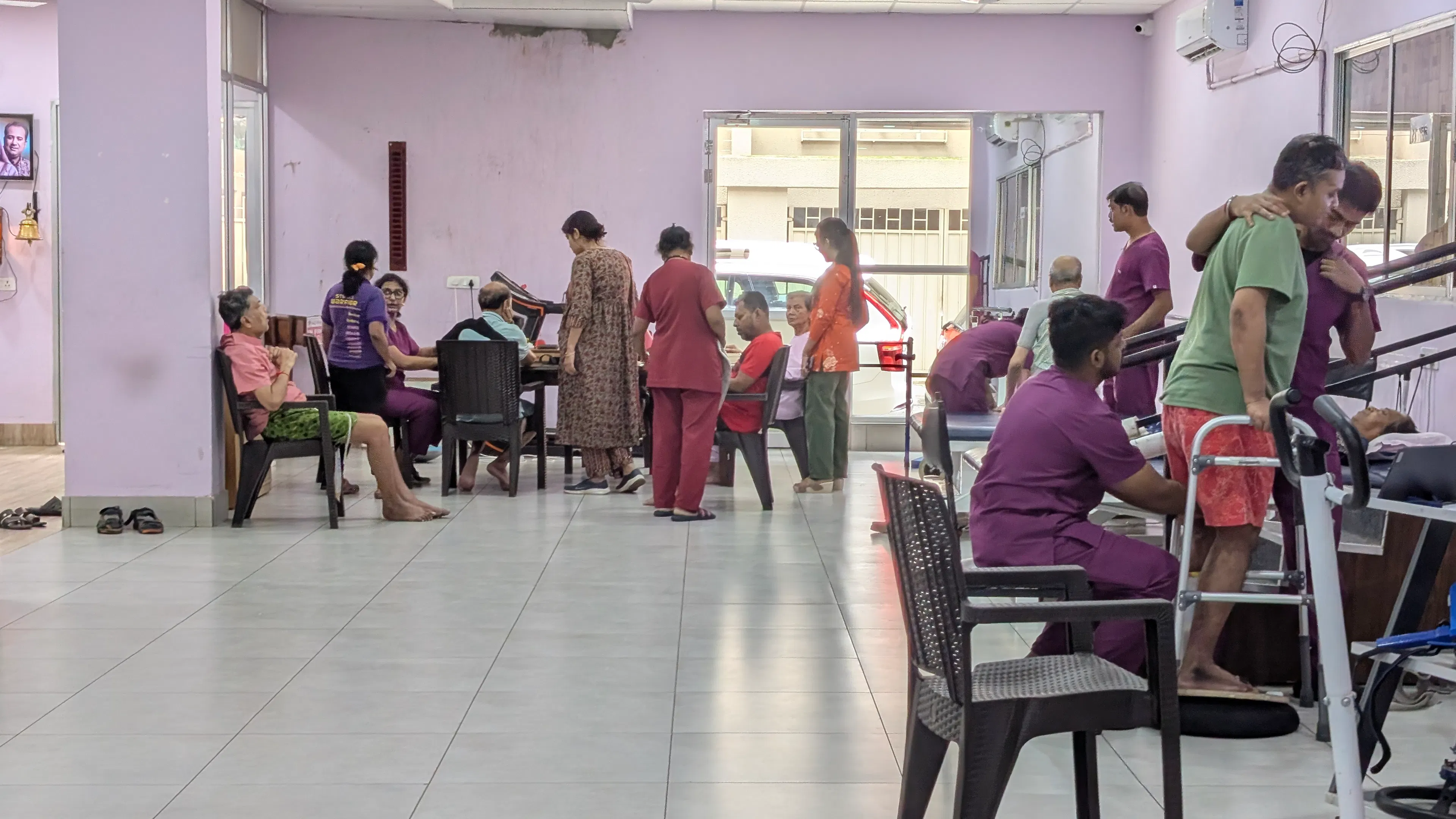
Busy therapy hall at Rehabana with patients and therapists

The team

The multidisciplinary team

Parkinson's affects many areas of life, so rehab works best as a coordinated team. At Rehabana, the team meets to review each patient's progress and agree next steps. Each person gets only the therapies their goals need. Our main Parkinson's disease page explains the condition and how it progresses.

  • PMR doctor: takes the history, checks fall risk, leads the plan and links with your neurologist
  • Physiotherapist: walking, balance, strength, posture, freezing and fall prevention
  • Occupational therapist: dressing, eating, writing, bathing, home safety and routines
  • Speech and language therapist: voice, speech, swallowing and drooling
  • Psychologist: mood, anxiety, thinking skills and behaviour changes
Physiotherapy for Parkinson's
Rehabana's step-by-step Parkinson's rehabilitation goals from bed mobility to walking outdoors

Goals by stage

How goals change at each stage

We stage Parkinson's with the Hoehn and Yahr scale and set goals to match.

In the early stages (1 to 2), the focus is on staying fit and active: regular aerobic and strength exercise, good posture, learning about the condition, and early speech therapy if the voice is changing.

In the middle stage (3), balance becomes a problem. Goals often include preventing falls, managing freezing with cues, keeping walking safe and making daily tasks easier.

In later stages (4 to 5), rehab helps with bed mobility, transfers, sitting posture, swallowing safety, preventing stiffness and pressure sores, and training family members to help safely. At Rehabana, most patients first come to us at Stage 3 or 4, so we strongly encourage starting earlier.
Rehabana's assessment and rehabilitation planning process

Measuring progress

Assessment, reassessment and why starting early matters

We use standard tests so progress can be measured, not guessed. These include the Timed Up and Go, Berg Balance Scale and Five Times Sit-to-Stand for physical ability, the Functional Independence Measure and Nine-Hole Peg Test for daily function, the MoCA for thinking, and the Gugging Swallowing Screen for swallowing. We repeat them at follow-up and update the goals.

Starting early makes a difference. It is easier to keep strength, balance and good habits than to rebuild them after falls and long periods of inactivity. Early rehab also gives families time to learn and plan. But it is never too late: people at every stage can gain safety, comfort and independence.

Occupational therapy for Parkinson's
Parkinson's rehabilitation at Rehabana, Kolkata

Ways to do rehab

Outpatient, inpatient and home programmes

Parkinson's rehabilitation can be delivered in different ways, and many people use more than one over the years. The right choice depends on your goals, how much support you need, how far you live from the centre, and how intensive the therapy needs to be.

Outpatient therapy suits most people, especially in the early and middle stages. You come to the centre for regular sessions with the therapists you need, then continue with a home exercise programme in between. It fits around work and family life and lets you practise in a well-equipped setting.

Inpatient rehabilitation means staying at the centre for a period of intensive, closely supervised therapy, usually several sessions a day. It can help after a fall, an illness or a hospital stay that has caused a sudden drop in ability, or when someone needs a short, focused burst of therapy that would be hard to manage from home. Rehabana offers inpatient rehabilitation for people who need this level of care.

A home programme is the part that never stops. Exercises, voice practice and daily routines done at home keep the gains from therapy going. Rehabana also offers digital rehabilitation services, which can help some people stay on track between visits. Ask whether it suits your needs.

Whichever option you choose, regular reassessment keeps the plan matched to your current abilities. Needs change in Parkinson's, so it is worth reviewing the approach at least once or twice a year, or sooner after any fall or hospital admission.

Speech and swallowing in Parkinson's

FAQs

Frequently asked questions

What does Parkinson's rehabilitation involve?

An assessment by a doctor and therapists, agreed goals, a programme of therapy such as physiotherapy, occupational therapy and speech therapy, a home exercise plan and regular reassessment.

Do you offer inpatient Parkinson's rehabilitation?

Is rehabilitation needed if medicines are working well?

Next steps

Book a Parkinson's rehabilitation assessment

Start with an assessment at Rehabana in Salt Lake or Kalighat, Kolkata. Our doctor-led team will agree goals with you and coordinate with your neurologist.