MS rehabilitation helps you keep doing the things that matter to you. Here is how a programme is planned, who is involved and what to expect.
Overview
MS rehabilitation is a planned programme of therapy that helps a person with multiple sclerosis stay as active, safe and independent as possible. It doesn't treat the disease itself. That is the job of your neurologist's medicines. Rehab works on the effects of MS on everyday life.
The aim is different for each person. For one, it might be walking to the bus stop without stopping. For another, it might be getting through a working day without crashing, or dressing without help. We start from what you want to do and work backwards to the therapy that gets you there.
Rehabilitation helps at every stage of MS: soon after diagnosis, after a relapse, and when the condition is slowly progressing.
Assessment and goals
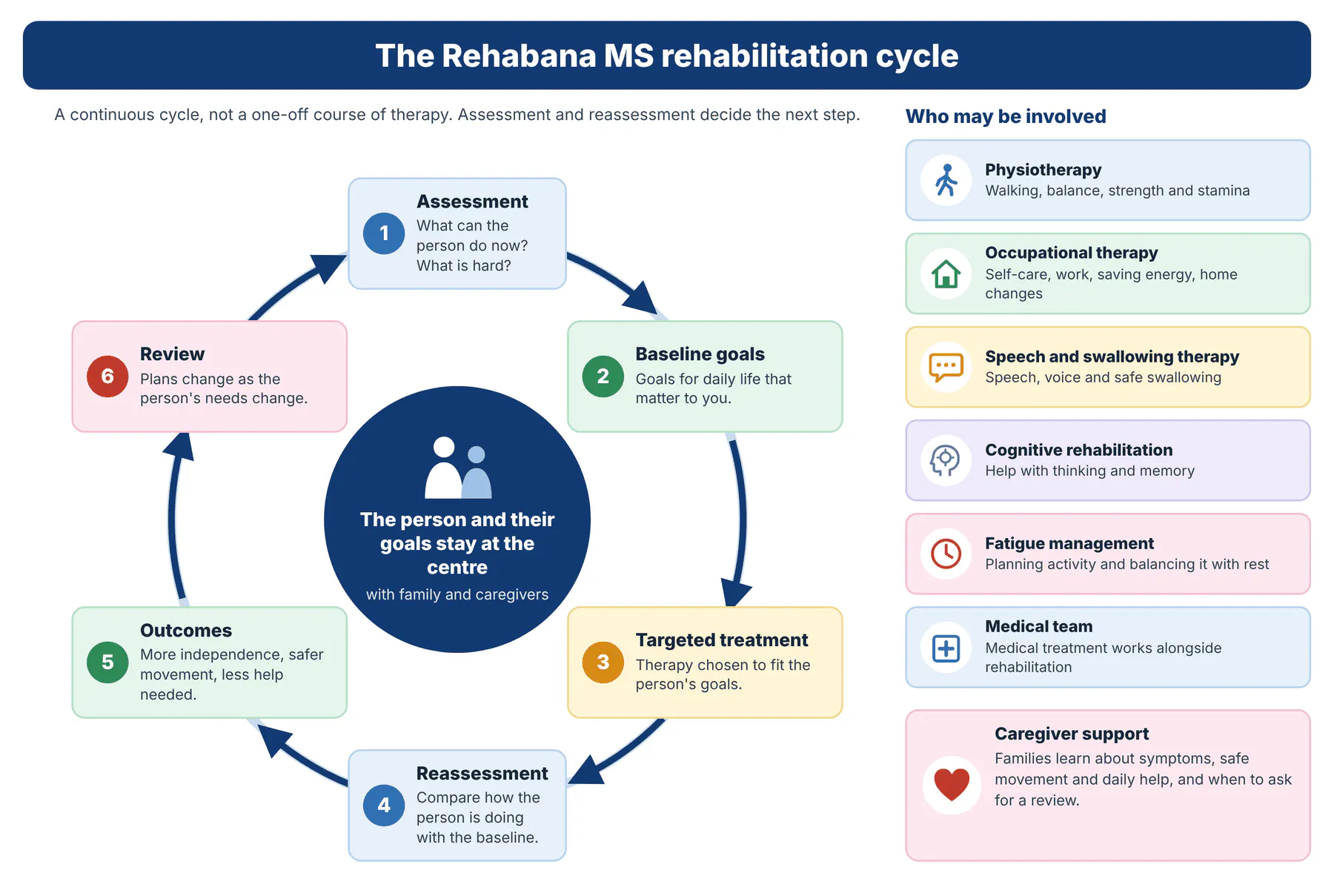
First, our PMR doctor takes your history, looks at your MS, your medicines, falls and other health problems, and checks for risks. Then our therapists assess how you move, balance, use your hands, think, speak and swallow, using standard tests so we can measure change later.
Tests may include the Timed Up and Go and Berg Balance Scale for mobility and balance, the Nine-Hole Peg Test for hand function, the Functional Independence Measure for daily activities, and a cognitive screen such as the MoCA.
Together, we agree two or three goals that are specific and meaningful to you. 'Walk to the temple and back with a stick' is a goal. 'Do leg exercises' is not.

The team
MS affects many systems, so rehab works best as a team. At Rehabana, the team meets to discuss each person's progress and adjust the plan. Not everyone needs every therapy. The plan includes only what your goals call for.

Review
We repeat the same tests at regular intervals to see whether the plan is working. If a goal is met, we set the next one. If progress stalls, we change the approach rather than carry on regardless.
MS is long-term, so rehab is not a one-off course. Many people do an intensive block of therapy, then move to a home programme with regular check-ins. They come back for another block after a relapse or when a new problem appears. In a progressive phase, keeping what you have and preventing falls, stiffness and pressure sores is a real and worthwhile goal.
We also involve families. Practical training for carers often makes as much difference as the therapy itself.
After a relapse
A relapse can take away abilities that were fine a few weeks earlier. Walking may become unsteady, a hand may stop working well, or fatigue may become overwhelming. This is frightening, but many people recover a good deal over the following weeks and months, and rehabilitation can support that recovery.
In the early days, while symptoms are at their worst, the focus is on rest, safety and comfort. Therapists help with positioning to prevent stiffness, safe ways to move around the home, and simple exercises that don't overtire you. If there is a risk of falls or you can't manage at home, a short period of inpatient rehabilitation may be the safest option.
As the relapse settles, therapy steps up. We reassess, compare the results with your earlier scores, and set goals to get back what you have lost: walking distance, hand skills, balance, or returning to work. Exercise is built up gradually, with close attention to fatigue and heat.
Not every relapse leads to full recovery. Where some difficulty remains, rehab shifts towards new ways of doing things, the right equipment and changes at home or work, so you can stay as independent as possible.
Always tell your neurologist about a suspected relapse first. They will decide whether medical treatment is needed, and we coordinate the rehabilitation around their plan.
FAQs
It depends on your goals and needs. Many people start with a few weeks of regular sessions, then continue with a home programme and periodic reviews. We set the length after your assessment and adjust it as you progress.
Next steps
Start with an assessment at Rehabana in Salt Lake or Kalighat, Kolkata. Our doctor-led team will agree goals with you and build a programme that fits your life.