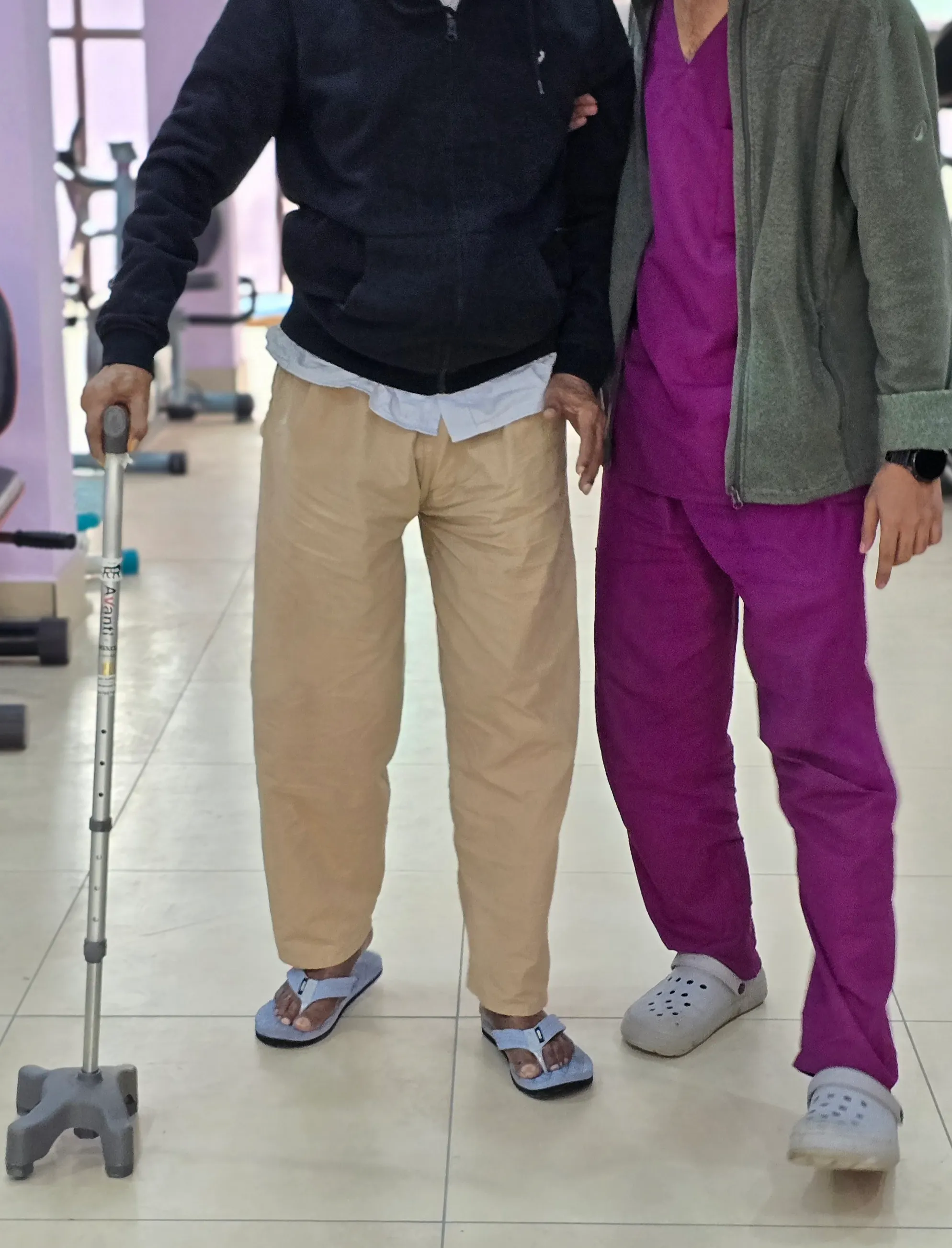
The Timed Up and Go (TUG) test checks how you stand up from a chair, walk a short distance, turn around and sit down again. Here is how it works, what your time means and how Rehabana uses it to track progress.

Walking and balance assessment
The Timed Up and Go test, or TUG test, checks how you stand up from a chair, walk a short distance, turn around and sit down again. A therapist records the time you take and watches how safely you move. It helps assess movement difficulties and possible risk of falling.
It is not a race. Moving safely matters more than finishing quickly.
Why we use it
The TUG test helps us set new, measurable rehabilitation targets based on the patient's current functional ability, such as walking. It allows us to assess improvement over time, identify the next rehabilitation goals and discuss the patient's progress with family members during periodic OPD reviews. Throughout the rehabilitation journey at Rehabana, TUG test scores are regularly recorded in the patient's assessment sheet to track progress and guide further rehabilitation planning.
The TUG test brings these movements together. It helps the therapist notice difficulties such as:
Who it is for
A therapist may use this assessment with older adults and people with movement difficulties after a stroke or with conditions such as Parkinson's disease. Whether it is suitable depends on the person's current abilities.
Case report example: A 67-year-old man with haemorrhagic stroke and spasticity received rehabilitation at Rehabana. His TUG time improved from 17.72 seconds on 14 August 2026 to 14.47 seconds on 3 November 2026, a reduction of 3.25 seconds.
How it works
You sit in a chair with armrests. A line is marked 3 metres away, about 10 feet. You can use your usual walking aid and wear your regular footwear. The therapist times the task, watches your movement and stays close for safety.
When the therapist says "Go," you:

Understanding the result
Your score is the time taken, in seconds. For older adults, the US Centers for Disease Control and Prevention uses a result of 12 seconds or more as a sign of increased fall risk that needs closer assessment. It does not mean that the person will definitely fall.
There is no single "normal time" for everyone. Your condition, walking aid and movement pattern matter too. A quick result does not guarantee safety, and the test should not replace a fuller assessment.
Case report example: A patient with Parkinson's disease (PD) and left-sided hemiparesis showed improvement in mobility during rehabilitation. The TUG time improved from 40 seconds (26/08/2026) to 35 seconds (01/09/2026), indicating a positive change in functional mobility.
At Rehabana, our physiotherapy team uses the TUG test alongside other assessments, such as the Berg Balance Scale and the Functional Independence Measure (FIM).
Book an Assessment
Our physiotherapists assess walking, balance and fall risk, then plan rehabilitation around your everyday goals at our Salt Lake and Kalighat centres in Kolkata.